
An overview and important application considerations
Milling operations have many pieces of equipment in the transformation process of converting wheat to value-added products.
Most machines utilize bearings as a machine component, as many as 686 bearings may be accounted for in the mill alone, excluding those hidden in gearboxes and perhaps rotary locks.
Energy needed to overcome the force of the process is provided by an electric motor rotating in one of two directions. The energy and motion are then redirected through a drive system to facilitate component motion at a specific speed and direction for designed operation. Bearings are the bridge between the prime mover and the designed operation. They support the load and provide smooth movement either rotational or linear in proper alignment while reducing friction and minimizing wear.
Proper bearing maintenance and operation minimizes energy loss by reducing friction (energy waste) and protects machine components by reducing wear. Monitoring and maintenance of bearings is an important and often shared task of both production and maintenance. Vendors may also play a role in bearing maintenance given developments including the Internet of Things (IoT) and artificial intelligence (AI).
The purpose of this first article in a series is to provide baseline information identify different bearing types, applications and design consideration made for bearing possibly encountered in your milling operation.
Common Bearing Types
There are four main types of bearings commonly found in grain milling operations they are: ball, roller, thrust and plain. Each is designed for handling different types of loading across the bearing as shown in Table 1 below. The load direction and type, as well as speed, are important criteria for bearing selection.
Given a bearing on a horizontal shaft, the radial load acts perpendicular though the shaft as in a roller mill, while the bearing load on a vertical drive shaft at the bottom of a sifter counterweight drive acts parallel through the shaft. Radial loads place stress on the outer diameter of the bearing while axial loads are distributed across rolling components.
Angular contact bearings (ball or roller) are designed to handle both axial and radial loading simultaneously. Failure to consider loading type in making a bearing selection can result in excessive friction, heat and spalling (premature heat-induced failure). Static load refers to the load a bearing can support statically with a slow-moving shaft, as would be the case with a hanger bearing in a screw conveyor.
Bearing Selection
Ideally the bearings in your facility have been properly selected for their application. Table 1 and information presented under bearing types identified load magnitude and direction as well as speed as critical selection factors.
Heavier loads are handled better by roller bearings than ball bearings for a given size. High speeds generate more heat than slow speeds, making ball bearings a better choice than roller bearings due to their reduced friction.
Physical constraints are an important consideration in selection process as shaft diameter dictates bore size and bearing housing must fit in allotted space allowing for ease of maintenance and replacement.
While shaft sizing may have been considered, ease of maintenance and replacement appears to have been considered as less important by some equipment designers.
Some considerations in bearing selection are somewhat less obvious to the operators and maintenance staff. These considerations include alignment compensation, precision and stiffness, as well as life and reliability. The ability to accommodate shaft deflection may require self-aligning bearings like spherical roller bearings to prevent failure.
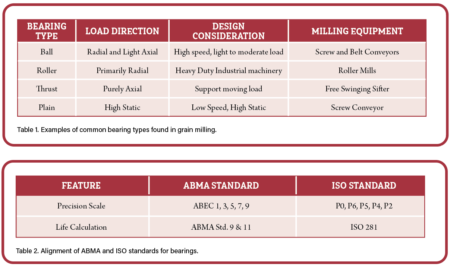
Tolerance class and rigidity are critical for machine tools and may be important even for specialized grinding operations. Of course, bearing life or L10 rating life, the number of hours 90% of identical bearings can reach before fatigue occurs is a critical factor in selection. Adaptation of high standards for these considerations can increase selected bearing life as well as cost.
Premature bearing failure due to improper selection, installation and maintenance can be costly and catastrophic. Short of blowing up the facility is unplanned down time and equipment damage which increase the cost of failure.
Rigorous standards for bearing precision and life expectancy are identified by The American Bearing Manufacturers Association (ABMA) are often approved by American National Standards Institute (ANSI) for use in the United States. The International Organization for Standardization (ISO) sets the global bearing standards. Fortunately, reports suggest these standards are well aligned as shown in Table 2 above.
Milling Application Considerations
General examples of milling equipment and bearing utilization were identified in Table 1. A bucket elevator, rotary lock, screw and drag conveyers in a milling operation run considerable slower than a roller mill, hammer mill or centrifugal fan for a pneumatic lift.
A bucket elevator in a grain mill’s elevator may handle 15,000 bushels per hour (bph) during a single shift per day while other bucket elevators handling dirty wheat to cleaning or tempered wheat to the mill at the same site are handling 1,200 bph for 24 hours per day.
In the elevator, the load is starting and stopping while trucks or rail cars are moved; however, the load on a mill’s bucket elevators is hopefully continuous and steady. In this comparison, we have shock loading and steady loading, continuous operation and intermittent operation. In addition, environmental differences could include dust level and type as well as temperature and relative humidity. Recognizing the start and stop operation of a bucket elevator in grain receiving having a drive exposed to extremes of temperature and moisture is a significant design and maintenance challenge.
Could one imagine the subtle difference in four transfer screw conveyors:
• One transferring dirty wheat to a bin prior to cleaning.
• Another delivering tempered wheat to the mill.
• For the last two, one carrying flour and the other feed.
If the screw transferring daily wheat use in six hours during first shift, the load would be approximately 288,000 pounds per hour, The screws carrying dirty wheat to cleaning and tempered wheat to the mill may carry a similar load of 72,000 pounds per hour.
However, lower-density tempered wheat may require a larger screw conveyor and different bearing design. The flour screw (assuming straight grade) would have to carry 52,500 pounds per hour, and the feed screw would carry 14,300 pounds per hour. Similarly, flour and feed have different bulk densities which impact screw conveyor design.
Roller mills must carry extreme weight and tolerate extreme pressure in their grinding operation, although at considerably slower speeds than a hammermill grinding screenings or millfeed. For legacy roller mills that once used clamshell style Babitt bearings (a plain bearing type as identified in Table 1), there are many bearing alternatives ranging in both price ($650-$2,500) and expected lifetime (seven to 20 years). These bearings differ in structural integrity (wall thickness, seals), number of component parts and sensitivity to human intervention (tightening and alignment).
With legacy rollstands, the rolls and roll bearings are mechanically removed and reinstalled one at a time. Either new prepared bearings or used bearings that have been removed inspected, cleaned and repacked are installed on the roll journals. Often, this occurs on the roll floor. If not handled carefully in a clean and safe manner, it can result in injury, bearing failure and journal damage. Proper training, cleanliness and following installation instructions is paramount to realize bearing life potential.
More recent roll designs utilize roll packs in which a pair of rolls is removed from the stand and is replaced with a fresh, reconditioned roll pack to speed up the repair day process. Bearing replacement can be more carefully managed and controlled in a cleaner and more open environment, allowing detailed inspection and cleaning of critical roll components.
The process of removing and installing bearings on a roll pack often includes the use of a hydraulic press-off and press-on devise. As with legacy roller mills, proper training, cleanliness and following installation instructions is paramount to realize bearing life potential. Today’s roller mill manufacturers usually provide maintenance instructions including bearing requirements and replacement procedures for their roller mill design. These instructions, as well as those of the bearing manufacturer, must be used and modified as needed to fit your mill’s conditions and mill crew competency.
Conclusion
The purpose of this article was to provide a brief introduction to the complex world of bearing application and selection. Bearing manufacturers provide detailed, in-depth explanations of bearing design and application, and you are encouraged to avail yourself of this information.
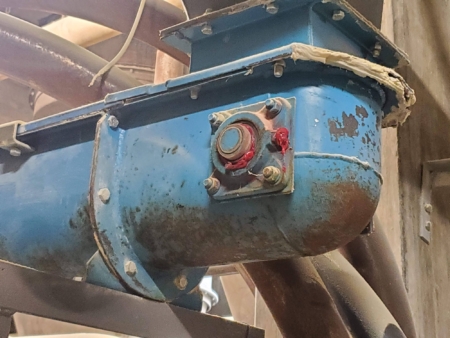
The next article in this series will identify specific bearing design differences in bearings from several mill applications identified in this article. Until then, try not to over lubricate as in Figure 1.
Dr. Jeff Gwirtz is CEO of JAG Services, Inc., an international consulting company in Lawrence, KS; 785-341-2371; jeff@jagsi.com. He also is adjunct professor in the Department of Grain Science and Industry at Kansas State University, Manhattan.