
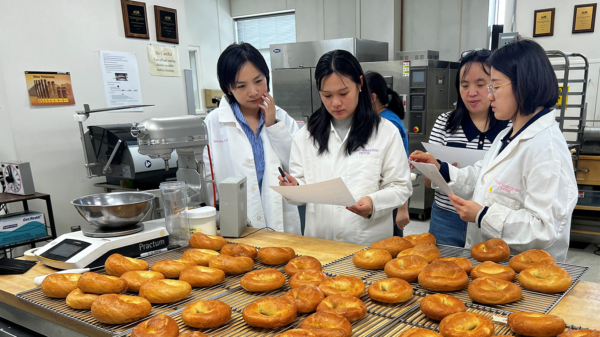
Photo credit: U.S. Wheat Associates.
U.S. Wheat Associates recently brought a delegation of Chinese millers and food manufacturers to the Wheat Marketing Center’s End Product Collaborative Short Course, where participants tested U.S. wheat classes and blends for a range of bakery products aimed at China’s premium food market.
Held June 7-14, the course focused on identifying which U.S. wheat classes, or combinations of classes, perform best for specific end products. The program is designed to help international customers refine existing product lines or develop new offerings by evaluating wheat functionality in practical baking applications.
The seven-member Chinese team included representatives from private milling and food manufacturing companies, with roles spanning research and development, grain merchandising and end-product marketing.
Led by Wheat Marketing Center Technical Director Dr. Jayne Bock and Food Scientist Dr. Andrew Mense, the course centered on producing Western-style baked goods that are gaining popularity in China, particularly in hotels and high-end restaurants serving international travelers.
Participants baked products including clover dinner rolls, ciabatta, bagels, focaccia, toast bread and sponge cakes, using various blends of U.S. wheat classes to measure performance and identify optimal formulations.
The results reinforced the role of the six U.S. wheat classes in delivering consistent quality across product categories, while also showing how blending different classes can fine-tune texture and performance.
For bagels and clover dinner rolls, the team found a blend of 70% U.S. dark northern spring wheat and 30% hard red winter wheat produced the strongest results. Ciabatta and focaccia performed better with lower levels of dark northern spring and more hard red winter wheat to achieve a softer but chewy texture.
For toast bread, the team determined that 100% dark northern spring wheat provided the preferred chewiness for the Chinese market. For Japanese-style sponge cakes, a premium bakery product in China, a blend of club wheat and U.S. soft white wheat delivered the best results.
In addition to the lab sessions, the delegation toured Dave’s Killer Bread, Marsee Baking and Oregon State University’s Food Innovation Center. The group also met with representatives from the U.S. wheat supply chain and visited local supermarkets to observe how flour and wheat classes are used in commercial operations.
USW said the program helps milling customers better understand how to apply U.S. wheat classes to meet specific flour specifications and end-product needs. The organization plans to continue working with the participants through in-plant technical support as they evaluate new product opportunities and potential U.S. wheat imports.
Source: U.S. Wheat Associates, "Chinese Team Explores the Blending Versatility of U.S. Wheat Classes at Wheat Marketing Center"