
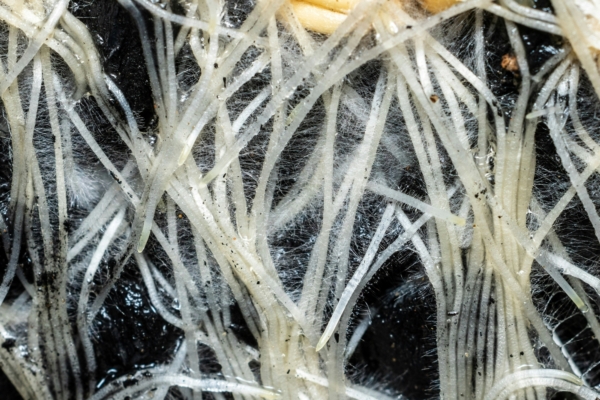
Researchers have identified significant genetic differences in winter wheat root intensity at deeper soil depths, providing new insight into root traits that may help wheat access resources in challenging environments.
Wheat is one of the world's most important cereal crops, but genetic variation in root traits, particularly those associated with deeper rooting, remains poorly understood. Root traits are generally controlled by many genes with small effects and often have low heritability, making genetic differences difficult to detect.
Researchers developed a statistical approach to analyze variation in root intensity across soil depths and determine where genetic differences are most detectable. The study used five years of phenotypic data collected each June at the RadiMax semi-field facility, which is designed to measure deep root systems.
The data included observations from 1,500 rows, with each row recording root intensity throughout the soil profile from 0.6 meters to 2.6 meters. A total of 513 winter wheat cultivars were grown at the facility over the five-year period, including 409 cultivars that were genotyped using SNP chips.
Researchers used depth-resolved regression models with random coefficients to quantify genetic and non-genetic variation in root intensity across soil depths while accounting for spatial variation between rows. Random variation within rows remained constant across depths.
The models showed that genetic variance for cumulative root intensity increased substantially below 1.1 meters. The deepest soil layers showed the largest differences among wheat lines, indicating that deeper portions of the root system may provide greater opportunities for detecting genetic variation.
Narrow-sense heritability of point measurements peaked at approximately 1.5 meters, with an estimated heritability of 0.13. The findings indicate that analyzing root traits by soil depth can help identify genetic differences that may otherwise be obscured when root systems are evaluated across the entire soil profile.
The results provide a statistical framework for studying the genetic basis of deep rooting in wheat and could support efforts to identify cultivars with root characteristics suited to environments where access to deeper soil resources is important.
Source: Springer Nature Link, "Deep soil layers show the most pronounced genetic variation in wheat root length"