
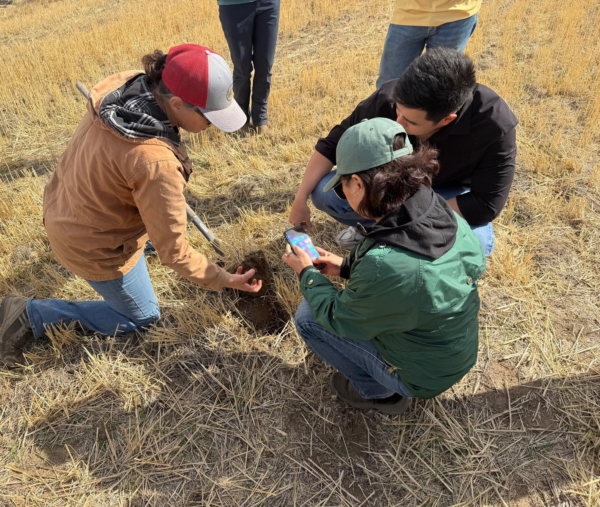
Photo credit: U.S. Wheat Associates.
The Northern Crops Institute (NCI) will devote its 2027 Grain Procurement Management for Importers program entirely to U.S. wheat, reflecting growing interest among international buyers in understanding how to purchase, manage and move U.S. wheat in the global marketplace.
The decision follows this year’s course, which included more than two dozen flour millers and purchasing agents sponsored by U.S. Wheat Associates (USW). USW staff from its Casablanca, Manila and Beijing offices brought participants to Fargo, North Dakota, for five days of classroom instruction before the group visited farms in North Dakota and export facilities in New Orleans and Portland.
“We’ve offered this course now for 43 years, and it has gotten big enough, there are enough participants from U.S. Wheat Associates alone to justify having a session specifically for wheat,” said Casey Peterson, program development manager at NCI. “It’s a pretty significant move, and it says a lot about the interest in wheat purchasing and procurement.”
Peterson plans to meet with USW Programs staff during the organization’s winter meetings in Washington, D.C., in February to begin developing the wheat-specific course.
Learning the Business
For international flour millers and importers, purchasing U.S. wheat involves futures prices, basis, freight, quality specifications and other factors. The NCI course gives buyers an opportunity to follow wheat through the supply chain and better understand the systems behind those transactions.
Over eight days, participants moved from classroom instruction to Northern Plains farms, elevators and transportation systems before visiting export facilities on the Mississippi River and in the Pacific Northwest. Along the way, they met farmers, grain handlers, traders and others involved in moving wheat from farms to flour mills around the world.
The classroom curriculum covered cash and futures markets, basis, hedging, grading standards, contracts, freight, supply and demand, logistics and weather forecasting. Participants also practiced futures trading and risk management in a simulated environment.
NCI added a progressive case study two years ago to help participants apply those lessons. Teams made up of participants from different countries, regions and occupations are assigned a fictional company and asked to develop a 12-month procurement plan. Each day brings new information and another decision, requiring teams to apply what they have learned.
Seeing the Supply Chain
Tarik Gahi, USW assistant technical director and administrative manager in Casablanca, brought commercial flour millers from Morocco and Egypt, along with representatives of the Moroccan milling federation and the Moroccan state grain agency.
“This cross-section of commercial buyers and regulatory stakeholders represented significant buying power and institutional influence across two of the region’s primary wheat import markets,” Gahi said.
Following wheat from North Dakota fields to river export terminals gave participants a closer look at the U.S. supply chain and the systems supporting its reliability, grading accuracy and logistical efficiency.
The case study reinforced those lessons, Gahi said. Teams considered market conditions, evaluated risk-management strategies and developed procurement plans before defending their decisions before their peers.
Building International Relationships
The course also gave buyers from different markets an opportunity to learn from one another.
Tyllor Ledford, USW assistant regional director for South and Southeast Asia, brought representatives from leading flour milling and grain trading companies in Thailand, Indonesia, the Philippines and Singapore.
“These markets collectively account for approximately 20% of total U.S. wheat exports and represent nearly one-third of the top 10 U.S. wheat export markets,” Ledford said.
Participants compared procurement practices, discussed market challenges and exchanged ideas about managing an increasingly complicated global wheat market.
Kaiwen Wu, USW marketing specialist in China and Hong Kong, brought two COFCO representatives, one responsible for hedging and the other for sales. It was their first USW overseas activity, Wu said.
The participants toured farms, observed U.S. inspection procedures and visited warehousing and transportation facilities. They also met directly with grain traders.
“They were deeply impressed by how American farms operate in an efficient and sustainable manner,” Wu said. “Their meeting with traders was highly practical, as it provided valuable face-to-face communication.”
Ledford, who previously worked as USW’s market analyst, said the personal interaction with U.S. industry can provide an important perspective for international buyers.
“A buyer can study a U.S. wheat specification from an office in Shanghai, Singapore, Casablanca or Cairo, but standing in a wheat field, walking through an elevator or talking face-to-face with a trader adds something a market report can’t provide,” she said.
Source: U.S. Wheat Associates, "After Effective 2026 Effort, NCI to Offer U.S. Wheat Its Own Procurement Course in 2027"